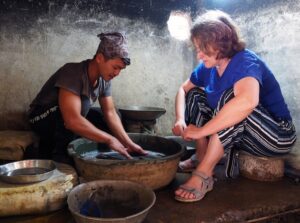
Monika Stankiewicz, Executive Secretary of the Minamata Convention on Mercury, learns how to pan for gold in a free-mercury mine in Baguio, the Philippines, in 2024. Credit: Minamata Convention on Mercury
By Kizito Makoye
SAMARKAND, Uzbekistan, Jun 5 2026 – Ask any woman miner in the Katoro goldfield in Tanzania’s northern Geita region, and she will tell you that she touches toxic mercury with her bare hands when extracting gold from crushed ore.
Many also say they carry the mercury-gold amalgam home and burn it in kitchens, exposing themselves and their families to toxic fumes that waft into the air.
For many women in Tanzania’s artisanal mining communities, the use of mercury is deeply embedded in their survival.
Globally, mercury used in artisanal gold mining contaminates rivers, enters fish and travels through Indigenous food systems – affecting distant communities.
Monika Stankiewicz, the United Nations’ Executive Secretary of the Minamata Convention on Mercury, warned this week that mercury pollution linked to artisanal gold mining continues to wreak havoc globally, with some women so fearful of the toxic metal’s effects that they are delaying motherhood.
During visits to mining communities in different countries, Stankiewicz said she heard stories that exposed the hidden human cost behind the global gold rush – where poverty often leaves families choosing between earning a living and protecting their health.
“I’ve heard women saying they are afraid to get pregnant because they are afraid their children will be affected by mercury,” Stankiewicz tells IPS on the sidelines of the Eighth GEF Assembly. “So it was really heartbreaking.”
Her account paints a grim picture of women and children exposed to hazardous mercury in domestic settings as the human toll of the global gold rush continues to grow, from Geita to Brazil’s Amazon despite visible risks to human health and ecosystems.
For Stankiewicz, the challenge extends beyond environmental regulation to the harsh reality facing millions of low-income miners worldwide, whose families struggle to survive today while carrying health risks that may last for generations.
“It is always a different context,” Stankiewicz said, recalling her years of interactions with artisanal miners.
“In different countries where I met with miners, the situation was quite specific. So it’s difficult to have one story that represents the entire informal sector,” she said.
Mercury pollution linked to artisanal and small-scale gold mining remains one of the world’s largest sources of human-generated mercury emissions.
In Tanzania, where roughly 1.2 million artisanal miners depend on gold for income, mercury is still widely used because it is cheap, accessible and effective at recovering gold.
Mercury is a toxic substance that attacks the central nervous system. According to Stankiewicz, exposure to the liquid metal may cause neurological damage, including memory loss and tremors, respiratory illness from inhaling mercury vapour, reproductive health impacts and harm to children’s developing nervous systems.
Children are particularly vulnerable.
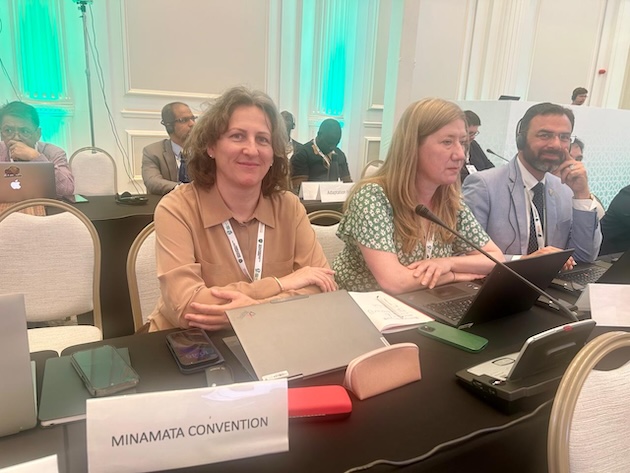
Monika Stankiewicz, Executive Secretary, Minamata Convention on Mercury at the Eighth GEF Assembly in Samarkand, Uzbekistan. Credit: Stella Paul/IPS
“Even low levels can affect brain development, learning and memory, and motor skills,” she said.
The consequences can be lifelong.
“We know from past experiences, such as the Minamata disease in Japan, that high levels of mercury exposure, particularly during pregnancy, can lead to severe and permanent neurological damage in children.”
In many artisanal mining communities, women process ore, store mercury and supervise the burning of amalgam to prevent theft.
“If they are not processing directly, they are often most trusted to either store the mercury or watch over the amalgam as it gets burnt to ensure it is not stolen,” Stankiewicz explains.
“They also face compounded risks during pregnancy, as mercury can affect the developing foetus they carry.”
The unsafe disposal of mercury in Tanzania has created a toxic mix in the country’s river system, exposing people downstream to serious health risks due to water and fish contamination, she added.
Mercury enters rivers, fish and agricultural systems, exposing communities who may never set foot inside a mine.
“For families and communities relying on fishing or farming, the impact can mean reduced food safety and food security, loss of income from contaminated natural resources and long-term degradation of ecosystems they depend on,” Stankiewicz says.
She notes that Indigenous communities in the Arctic continue to experience mercury contamination, even though they do not engage in mercury-intensive artisanal mining, because mercury circulates globally through the atmosphere before accumulating in colder ecosystems.
In Brazil, the crisis carries another dimension.
“Despite their distance and very different contexts, both regions reflect a similar underlying reality: artisanal and small-scale gold mining exists at the intersection of livelihoods, informality, and, in some cases, illegality,” she says.
“In the Brazilian Amazon, we are seeing a growing presence of organised criminal networks linked to illegal gold mining, including money laundering, gold laundering, illegal mercury supply chains, and operations in protected and Indigenous areas.”
“In East Africa, including Tanzania, the situation is different in scale and structure, but the sector is still affected by widespread informality and illicit trade, such as smuggling and unregulated cross-border flows, which limit oversight and undermine efforts to control mercury use.”
For Stankiewicz, criminalising poverty does not solve the mercury problem.
She recalls meeting miners who had already stopped using mercury but remained trapped outside formal markets.
“They still struggled to formalise their activities and to have access to formal markets, to have a fair price for their gold and also to protect themselves from illegal activities.”
The lesson, she said, is that governments must avoid pushing miners deeper underground.
“It’s important to work directly with miners and not push them underground so that activity becomes fully illegal, because then it’s difficult to reach out with capacity building and awareness raising.”
Her message to a miner in Geita or the Brazilian Amazon is grounded in empathy rather than judgement.
“First of all, I would say that this is a very difficult choice for any family member or parent to either think of earning money or then also put at risk their own health.”
“So I do not wish anyone to be in a situation to make such a choice.”
Still, she urges immediate protective action.
“The most immediate and practical advice is really for miners to protect themselves from mercury exposure and to avoid certain practices that really may affect their health.”
“This is like burning amalgam in residential areas and also open burning.”
She believes the long-term answer lies elsewhere.
“Formalisation is the way to go.”
The Minamata Convention, which entered into force nearly a decade ago, has increasingly focused on helping countries move in that direction. Between 1 July 2022 and 30 June 2025 the GEF committed USD 174.0 million for programming to support the implementation of the Convention under its eighth replenishment.
Earlier this week, the 71st Council of the Global Environment Facility (GEF) also acknowledged USD 200 million for smaller projects, including support for countries’ national implementation plans under the Stockholm Convention on Persistent Organic Pollutants and work to address mercury in artisanal and small-scale gold mining under the Minamata Convention on Mercury.
Under Article 7 and National Action Plans, governments are encouraged to eliminate the most dangerous practices, strengthen public health responses, formalise mining operations and introduce mercury-free technologies.
Progress, Stankiewicz says, is visible.
More countries have adopted action plans, more governments have recognised ASGM as a significant sector, and communities are becoming increasingly aware of mercury’s risks.
“On the ground, this is translating into concrete measures: the introduction of mercury-free technologies in some mining areas, stronger regulatory frameworks, efforts to formalise parts of the sector, and increasing integration of health considerations into national responses.”
But she warns against celebrating too early.
“The next phase, and the real test, is ensuring that these efforts are aligned with realities on the ground, sustained, scaled, and translated into lasting improvements in the lives of mining and downstream communities.”
For communities in Tanzania and Brazil that depend on gold, the challenge remains unresolved.
Gold still brings income.
Mercury still brings risk.
And between the two lies a difficult question millions of families continue to confront every day: how to survive today without sacrificing tomorrow.
Note: The Eighth Global Environment Facility Assembly is underway until June 6, 2026, in Samarkand, Uzbekistan.
This feature is published with the support of the GEF. IPS is solely responsible for the editorial content, and it does not necessarily reflect the views of the GEF.
IPS UN Bureau Report
!function(d,s,id){var js,fjs=d.getElementsByTagName(s)[0],p=/^http:/.test(d.location)?’http’:’https’;if(!d.getElementById(id)){js=d.createElement(s);js.id=id;js.src=p+’://platform.twitter.com/widgets.js’;fjs.parentNode.insertBefore(js,fjs);}}(document, ‘script’, ‘twitter-wjs’);



![Claude Gascon, interim CEO of the GEF and Aziz Abduhakimov, [...] <a class=](https://www.ipsnews.net/Library/2026/06/claude-photo-300x225.jpeg) Read more »
Read more »![Her Excellency Saida Mirziyoyeva, chief advisor to the [...] <a class=](https://www.ipsnews.net/Library/2026/06/HE-Uzbekistan-300x225.jpeg) Read more »
Read more »
![Fear, stigma and discrimination still affect whether people with [...] <a class=](https://www.ipsnews.net/Library/2026/06/albinism-300x111.jpg) Read more »
Read more »